
North Slope Borough Genealogy Records
Genealogy research in North Slope Borough reaches into one of the most remote and historically layered regions of Alaska, covering the vast Arctic Slope from the Brooks Range to the Arctic Ocean and home to Inupiaq communities whose families stretch back thousands of years. Records for this region include Alaska Village Census Rolls, military service and draft registration files, state vital statistics, and the cultural archives held by the Inupiat Heritage Center in Utqiagvik. Researchers also find useful context through the National Park Service records for Gates of the Arctic and the North Slope Borough's own government archives for post-1972 administrative history.
North Slope Borough Overview
North Slope Communities and Their Records
North Slope Borough is the largest borough by land area in the United States. Its eight communities - Anaktuvuk Pass, Atqasuk, Kaktovik, Nuiqsut, Point Hope, Point Lay, Utqiagvik, and Wainwright - are spread across an area the size of Wyoming. Each community has a distinct history and its own record sources. Understanding which community your ancestor lived in will help narrow your research significantly.
Utqiagvik, formerly known as Barrow, is the northernmost community in the United States. It has been a major Inupiaq settlement for centuries and the administrative center of the borough since its creation in 1972. Utqiagvik holds the most records locally of any North Slope community. Point Hope is believed to be one of the oldest continuously occupied communities in North America, with a rich cultural record of whaling and Inupiaq life that is documented in NPS and oral history archives. Anaktuvuk Pass in the Brooks Range was permanently settled in 1949 by a group of nomadic Inupiaq families, making it one of Alaska's youngest permanent communities despite being home to one of the state's oldest cultural traditions.
Population figures show the region's growth: 2,141 in 1960, 2,928 in 1970, 4,199 in 1980, 5,979 in 1990, 7,385 in 2000, and 9,430 in 2010. Much of this growth came from oil development on the North Slope, which brought non-Native workers and infrastructure investment beginning in the 1970s. Understanding this demographic shift helps researchers interpret records from different eras.
Alaska Village Census Rolls and State Archives Records
Alaska Village Census Rolls from 1919 to 1972 are the backbone of genealogy research for North Slope Borough communities. These rolls, available through FamilySearch, documented the populations of Alaska Native villages at regular intervals over more than five decades. Each roll typically lists household members by name, age, and relationship, making them a key source for tracing Inupiaq family lines across generations.
The rolls were created by federal and territorial government agencies and reflect the administrative structure of the time. Not every community was enumerated every year, and spelling of Inupiaq names varied from one census to the next. Checking multiple years of rolls and comparing name variations is important. The Alaska State Archives genealogy portal explains how to access these collections and what supplementary records may be available for specific communities.
Military Service Discharge Records from 1898 to 1934 at the Alaska State Archives can document North Slope men who served in early military conflicts or who were registered during World War I. WWII Draft Registration Cards from 1940 to 1945 on FamilySearch provide another check for North Slope residents during the war years. Both collections can confirm an individual's community of residence and sometimes their Alaska Native village affiliation.
For recent vital records, the Alaska Division of Public Health Vital Records Office handles certified copies statewide. Under Alaska Statute 18.50.290, birth records under 100 years old are restricted. Death, marriage, and divorce records under 50 years old are protected under AS 18.50.300.
Inupiat Heritage Center Records and Cultural Archives
The Inupiat Heritage Center in Utqiagvik is managed through a partnership between the North Slope Borough and the National Park Service as part of the New Bedford Whaling National Historical Park network. It serves as the main cultural repository for Inupiaq heritage, oral histories, and documentation of Arctic whaling traditions.
The Inupiat Heritage Center in Utqiagvik holds oral history recordings, cultural records, and documentation of Inupiaq life on the North Slope, making it a key resource for family history research in the region.
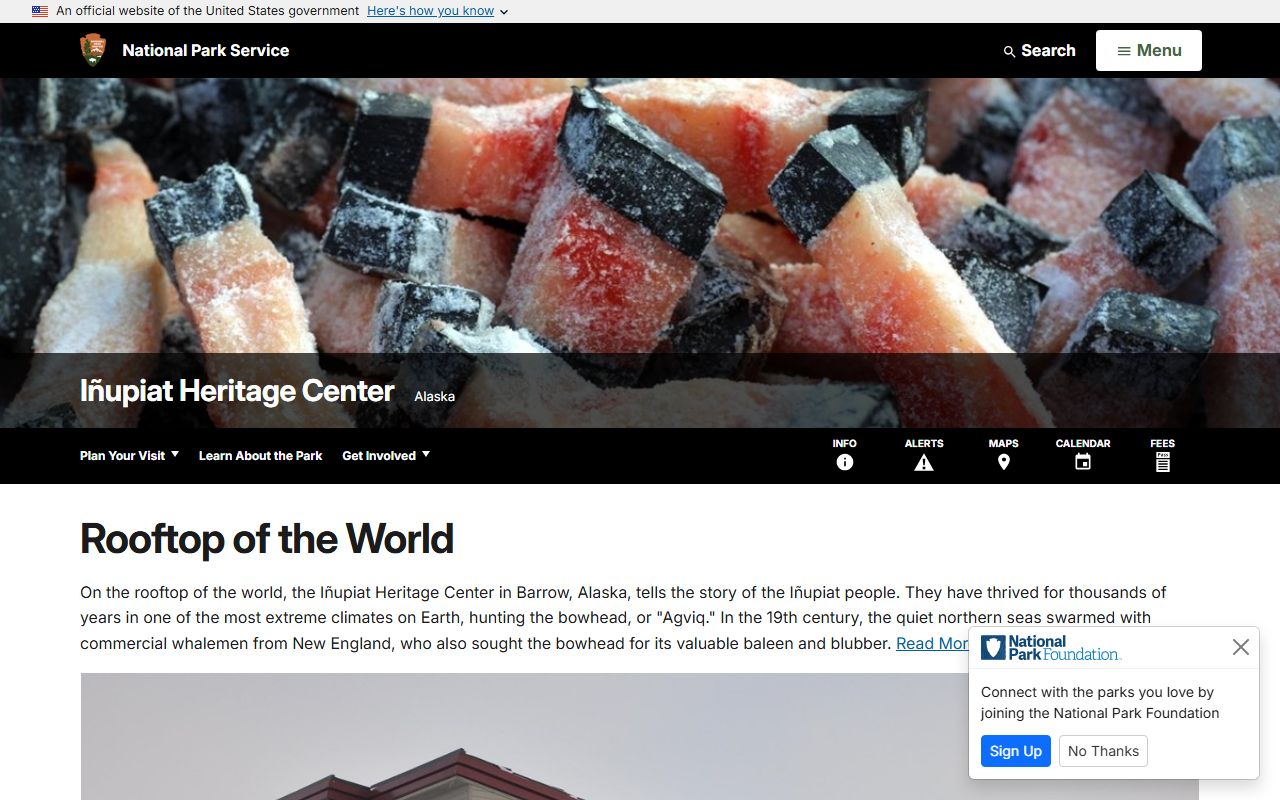
The Heritage Center's oral history collection documents Inupiaq families in ways that formal government records never could. Oral histories name ancestors, describe migration patterns between seasonal camps, and record traditional knowledge passed down through generations. For families whose pre-1900 history is not captured in any written record, oral histories at the Heritage Center may be the only surviving account. Staff can help researchers understand what is in the collection and how to access it appropriately.
Whaling records are particularly significant for North Slope genealogy. Inupiaq whaling crews are organized by family and kinship networks, and the record of who captained a crew and who served as crew members across generations reflects family structures going back centuries. The Heritage Center holds documentation of bowhead whale hunting that is not available anywhere else.
Gates of the Arctic and Federal Records
Gates of the Arctic National Park and Preserve covers the central Brooks Range, which is the southern boundary of North Slope Borough. The park holds historical records, oral histories, and documentation of Nunamiut Inupiaq families who inhabited the Brooks Range interior before and after the establishment of Anaktuvuk Pass as a permanent village.
The Gates of the Arctic National Park holds archival materials related to the Brooks Range communities and the Nunamiut Inupiaq families who established Anaktuvuk Pass as a permanent settlement in 1949.
The National Archives at Seattle holds Bureau of Indian Affairs records for Alaska. These records cover a wide range of materials including enrollment records, land allotment files, school records, and agency correspondence. For North Slope families, BIA records from the Barrow Agency and related administrative offices can provide genealogical data not found in state archives. School records, in particular, can document children and their parents at specific villages during the early and mid 20th century.
Federal census records are another key resource. Alaska was enumerated in U.S. federal censuses beginning in 1880, and North Slope communities appear in various census years from 1900 onward. Census records are available through FamilySearch and Ancestry for years before the 72-year restriction applies. The 1940 census is now fully open. Census records name household members, list ages, and sometimes include birthplace information that can point toward further research.
North Slope Borough Government Records
The North Slope Borough government was created in 1972, just before the Trans-Alaska Pipeline brought major oil revenue to the region. The borough holds its own administrative records covering land use, local ordinances, and government services since that date. While these are not genealogy records in the traditional sense, they can document when families moved to or from specific communities and what services they received.
The borough's school district records document students in North Slope communities from the 1970s onward. School enrollment records can confirm a family's presence in a community at a specific time. Earlier school records, from the territorial period, are at the Alaska State Archives and the National Archives at Seattle through BIA records.
Land records for North Slope Borough are important for Alaska Native land claims research. After the Alaska Native Claims Settlement Act of 1971, ANCSA corporations were established for North Slope communities. The Arctic Slope Regional Corporation (ASRC) is the main ANCSA corporation for the region. ASRC and village corporation records can document Alaska Native shareholders and their descendants, which is a form of genealogical record. The Alaska Historical Society provides leads on these resources.
FamilySearch and Online Research Tools
The FamilySearch North Slope Borough genealogy guide is the best online starting point. It lists all digitized collections that are available as free images and provides links to related guides for Alaska as a whole and for neighboring regions.
The VILDA Alaska digital archive holds photographs and some documents from North Slope communities. Images from Barrow, Point Hope, and other Arctic villages can help researchers understand the communities where their ancestors lived. The Lost Alaskans database is another specialized tool that can help connect names to places and dates. The Alaska State Library genealogy guide provides statewide leads on secondary sources, newspaper indexes, and cemetery records.
Nearby Borough Genealogy Resources
North Slope Borough borders two other large jurisdictions whose records may intersect with North Slope family research. Families moved between Arctic regions for seasonal subsistence, trade, and eventually for work and education.
Northwest Arctic Borough to the southwest covers the Kotzebue Sound area and has Inupiaq communities with close cultural and family ties to North Slope communities. Many families have connections across both boroughs, and records in both jurisdictions may be relevant. Yukon-Koyukuk Census Area to the south covers the vast interior, and some North Slope families have historical ties to Athabascan communities along the Yukon and Koyukuk rivers. The National Archives at Seattle holds records for both regions.